
Adrien-François Servais
Look at your endpin and thank Belgium. How Adrien-François Servais, the "Paganini of the cello," changed how cellists hold the instrument.
WORLD CUP TRIBUTE SERIES
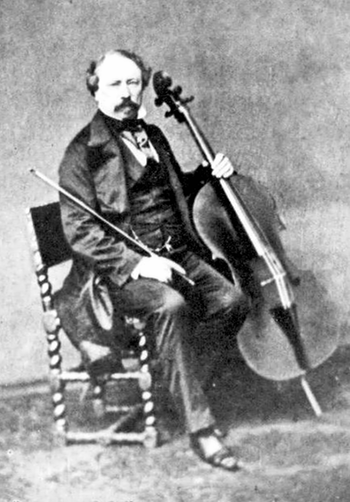
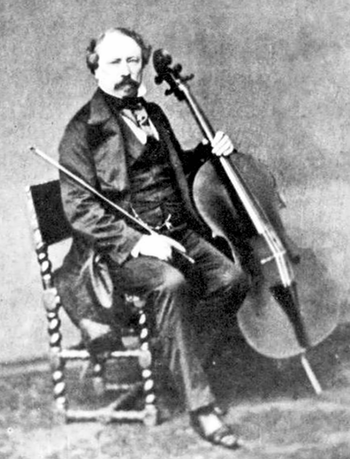
Look down at your endpin. Now thank Belgium.
Adrien-François Servais (1807–1866) was born and died in Halle, a small city near Brussels, and in between, he became, in Berlioz's words, the Paganini of the cello. Trained first as a violinist, he switched to the cello, studied with Nicolas-Joseph Platel, and, within a year and a half, was assisting his own teacher. From his Paris debut in 1833, he built one of the great touring careers of the century: London, the Netherlands, an eighteen-month Russian tour, appearances with Liszt, Mendelssohn, Clara Schumann, and the royal courts of Europe. Contemporaries marveled at his acrobatic technique, powerful tone, and, this raised eyebrows at the time, his generous use of vibrato, then still considered an exotic effect rather than a default.
Two things make Servais matter to every cellist alive today.
First, the endpin. Servais was one of the first major virtuosos to adopt and champion the spike, playing with it consistently at a time when purists like Alfredo Piatti held the cello between the calves their whole lives. (Credit is shared: Lise Cristiani's use of the endpin in the 1840s–50s helped popularize it, especially for women cellists. See Post 1 of this series.) It's worth being precise here, because "Servais invented the endpin" is one of those simplifications that hides a better story: the endpin wasn't a single invention but a practice that had to win a culture war, and Servais's stature helped it win. Popular legend says his girth demanded it; his technique certainly exploited it. Freed from gripping the instrument, the left hand could roam, and Servais's long thumb-position passages pushed the cello's upper register outward for everyone who came after.
Second, the school. From 1848, Servais taught at the Brussels Conservatory, and with his friend Auguste Franchomme, he helped found what became the Franco-Belgian cello school whose lineage runs toward Casals and beyond. Notably, Servais championed women cellists at a time when that was rare, admitting Hélène de Katow to his Brussels class in 1861.
The relics of this life are scattered wonderfully across the world. His 1701 Stradivarius, the "Servais," built from wood Stradivari reserved for his finest large instruments, is the crown jewel of the Smithsonian's instrument collection in Washington. And in Halle's market square stands a statue of Servais with his cello, sculpted by his own son-in-law, Cyprian Godebski. (Trivia for the art lovers: Godebski's daughter, Servais's granddaughter, was Misia Sert, the legendary Parisian muse of Ravel, Renoir, and Diaghilev. Musical dynasties take strange turns.)
Listen
Servais, Souvenir de Spa, Op. 2 (Sol Gabetta)
Servais, Cello Concerto in B minor, Op. 5 (Wen-Sinn Yang)
Servais, Fantaisie burlesque (Le Carnaval de Venise), Op. 9 (Didier Poskin)
Sources and further reading
Wikipedia, "Adrien-François Servais" (https://en.wikipedia.org/wiki/Adrien-Fran%C3%A7ois_Servais)
Smithsonian, the "Servais" Stradivarius (https://www.si.edu/object/stradivarius-violoncello-servais:nmah_214477)
Repertoire Explorer, Servais Cello Concerto Op. 5 (biographical essay) https://repertoire-explorer.musikmph.de/en/product/servais-adrien-francois-2/
Adrien-François Servais (1807–1866). Public Domain: https://commons.wikimedia.org/w/index.php?curid=617863