
Two Swiss Stories
Two Swiss stories for cellists: the alphorn's "wrong" note that tells the truth, and a legendary birthday present from Basel. From my World Cup series.
WORLD CUP TRIBUTE SERIES
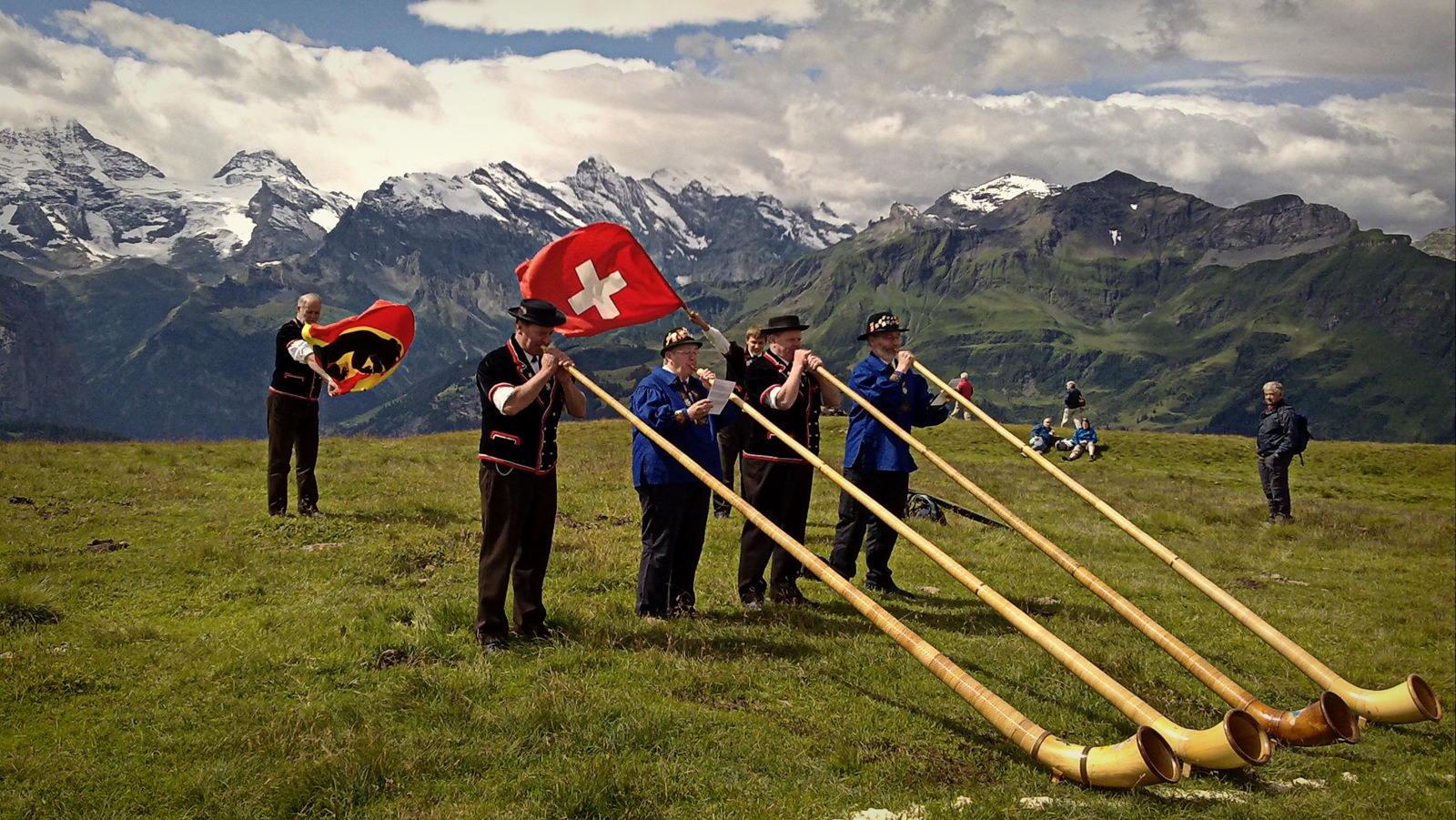
Switzerland gets one post but earns two stories: one about a "wrong" note that is actually the truth, and one about the most remarkable birthday present in cello history.
Story #1: the alphorn's honest F
The alphorn is a tube of wood three to four meters long with no valves, no keys, no holes. It can play only the natural harmonic series; the pitches physics hands you for free. And physics, it turns out, does not agree with your piano. The 11th partial of the series sits stubbornly between F and F sharp (on an instrument in C); Swiss tradition names it the alphorn-fa, and treats it not as an error but as a signature. Melodies that lean on the alphorn-fa carry a floating, Lydian-tinged color that equal temperament simply cannot spell. (The 7th partial is similarly gorgeously "flat.") Most Swiss alphorns are built with a fundamental of F sharp, and when their sound drifts across a valley, you are hearing the raw harmonic series at a landscape scale.
Composers noticed. Brahms, hiking in the Alps in 1868, jotted down an alphorn melody on a birthday card to Clara Schumann; it resurfaced, transfigured, as the great horn call in the finale of his First Symphony. Rossini and Beethoven both drew on the ranz des vaches, the Swiss herding melody, in William Tell and the Pastoral.
Why do I love this as a cello teacher? Because your cello contains an alphorn. The harmonic series lives on every string. Touch the string lightly at the halfway point, the third, the quarter, the fifth, and the partials speak, the same ladder of nodes that maps your entire fingerboard geography. Go far enough up that ladder, and you meet the same "out-of-tune" 7th and 11th partials the alphornist plays proudly. They are not out of tune. They are out of temperament, which is a human negotiation, not a law of nature. Understanding that distinction, I'd argue, is the beginning of nuanced intonation.
Story #2: eSACHERe
Paul Sacher of Basel married into a pharmaceutical fortune and spent it in the twentieth century. As conductor and patron, he commissioned a staggering catalog of masterpieces. Bartók's Music for Strings, Percussion and Celesta and Stravinsky's Concerto in D exist because of him. For Sacher's seventieth birthday in 1976, Mstislav Rostropovich had an idea worthy of the man: he asked twelve composers, Beck, Berio, Boulez, Britten, Dutilleux, Fortner, Ginastera, Halffter, Henze, Holliger, Huber, and Lutosławski, to each write a solo cello piece built from the six letters of SACHER, rendered in musical notation as the hexachord E♭–A–C–B–E–D.
The result, the 12 Hommages à Paul Sacher, is a core sample of modern music: twelve wildly different minds solving the identical six-note puzzle on the identical four-stringed instrument. Several escaped the birthday party entirely. Dutilleux's Trois strophes sur le nom de Sacher and Lutosławski's Sacher Variation are now standard repertoire, and Boulez's Messagesquisse (for solo cello plus six more) became one of his most-performed works. The Swiss brothers Thomas and Patrick Demenga recorded the complete set for ECM, an ideal single album for any student who thinks solo cello ends with Bach.
Listen
12 Hommages à Paul Sacher — Thomas & Patrick Demenga (ECM): https://ecmrecords.com/product/12-hommages-a-paul-sacher-pour-violoncelle-patrick-demenga-thomas-demenga/
Dutilleux, Trois strophes sur le nom de Sacher (Capucon); Lutosławski, Sacher Variation (Schiff); Boulez, Messagesquisse (Queyras)
Traditional alphorn playing (DW feature)
Alphorn call from Brahms, Symphony No. 1, finale
Sources and further reading
Swiss Federal Office of Culture, "Playing the alphorn and the Büchel" — https://www.lebendige-traditionen.ch/tradition/en/home/traditions/playing-the-alphorn-and-the-buechel.html
Wikipedia, "Alphorn" — https://en.wikipedia.org/wiki/Alphorn and "Sacher hexachord" — https://en.wikipedia.org/wiki/Sacher_hexachord
Gramophone review of the 12 Hommages — https://www.gramophone.co.uk/reviews/12-hommages-%C3%A0-paul-sacher
Grindelwald Alphorn players. By Cristo Vlahos - Own work, CC BY-SA 3.0, https://commons.wikimedia.org/w/index.php?curid=23283283