
The Cello and the Nightingale
In 1924, cellist Beatrice Harrison played to the nightingales in her Surrey garden, live on the BBC. England's entry in my World Cup tribute series.
WORLD CUP TRIBUTE SERIES
Before there was "going viral," there was a woman in a ditch in Surrey with a cello.
On the evening of 19 May 1924, the English cellist Beatrice Harrison sat half in and half out of a ditch in her garden at Oxted, surrounded by cables, amplifiers, and a revolutionary new microphone, while BBC engineers held their breath. It was the BBC's first live outdoor broadcast — the corporation was barely two years old — and the plan was, frankly, absurd: Harrison would play, and with luck, the wild nightingales in her woods would sing along, live, into the homes of the nation.
She had discovered the phenomenon by accident. Practicing outdoors on summer evenings, she noticed a nightingale answering and echoing her cello. Night after night the duet repeated, until Harrison managed to persuade a deeply skeptical John Reith, the BBC's general manager, to broadcast it. No wild bird had ever been broadcast in its natural state; even the engineers thought it impossible.
The bird sang. Listeners across Britain — and, via relay, far beyond — heard cello and nightingale together in real time. The response was staggering: some 50,000 letters poured in, some addressed simply to "the Lady of the Nightingales, England." King George V reportedly told her she had encircled the empire with the nightingale's song. The broadcasts were repeated every spring for the next twelve years, and in 1927, His Master's Voice captured commercial recordings — Harrison playing "Londonderry Air" and Dvořák's "Songs My Mother Taught Me" amid live birdsong — which you can stream free today on the Internet Archive.
Why did it land so hard? Historians point out that, in 1924, Britain was still in deep mourning after the Great War. A new technology delivering something ancient — birdsong, a cello, a garden at dusk — reached people that concerts couldn't. It's an early lesson in something musicians still wrestle with: sometimes the most powerful performance is the one that listens as much as it plays.
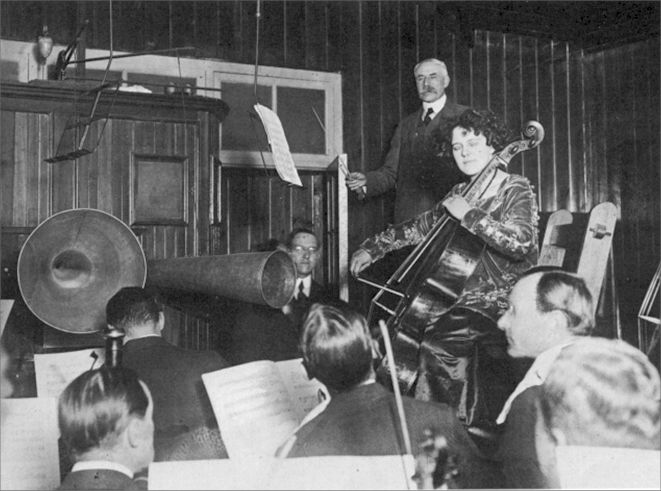
There's a bittersweet coda. Harrison was already one of the great cellists of her era before any bird sang: Delius wrote his Cello Concerto and Sonata for her, and Elgar chose her to record his Cello Concerto under his own baton in 1928, helping rescue the work's reputation after its disastrous premiere. Yet fame filed her under "nightingale lady." (Decades later, a claim surfaced that the first broadcast was faked with a professional bird-whistler; the BBC's own centenary documentary and biographer Kate Kennedy have pushed back firmly, noting no documentary evidence supports it — and that no recording of the live 1924 broadcast even exists to fake.)
Listen
Beatrice Harrison with nightingales, 1927 HMV recordings — free on the Internet Archive: https://archive.org/details/2-beatrice-harrison-garden-dawn-hmv-b-2469
Elgar, Cello Concerto (Harrison with the composer conducting, 1928)
Sources and further reading
Strings Magazine, "How Cellist Beatrice Harrison's 1924 Duet with a Nightingale Captured the Attention of the World" https://stringsmagazine.com/how-cellist-beatrice-harrisons-1924-duet-with-a-nightingale-captured-the-attention-of-the-world/
Wikipedia, "Beatrice Harrison" https://en.wikipedia.org/wiki/Beatrice_Harrison
Rob Skinner, "The nightingale and the cello 1924: broadcasting's first viral moment" https://robskinner.net/2024/05/21/the-nightingale-and-the-cello-1924-broadcastings-first-viral-moment/
Harrison and Elgar on the recording session of Elgar's Cello Concerto at His Master's Voice studio, November 1920. By Vol. 12, No. 4, The Early Piano I (Nov., 1984), p. 481., Public Domain, https://commons.wikimedia.org/w/index.php?curid=16967661