
The Cellist Inside the Tango
Everyone knows Piazzolla. Meet José Bragato, the cellist beside him who gave the cello a seat in tango. Argentina's entry in my World Cup tribute series.
WORLD CUP TRIBUTE SERIES
7/10/20262 min read
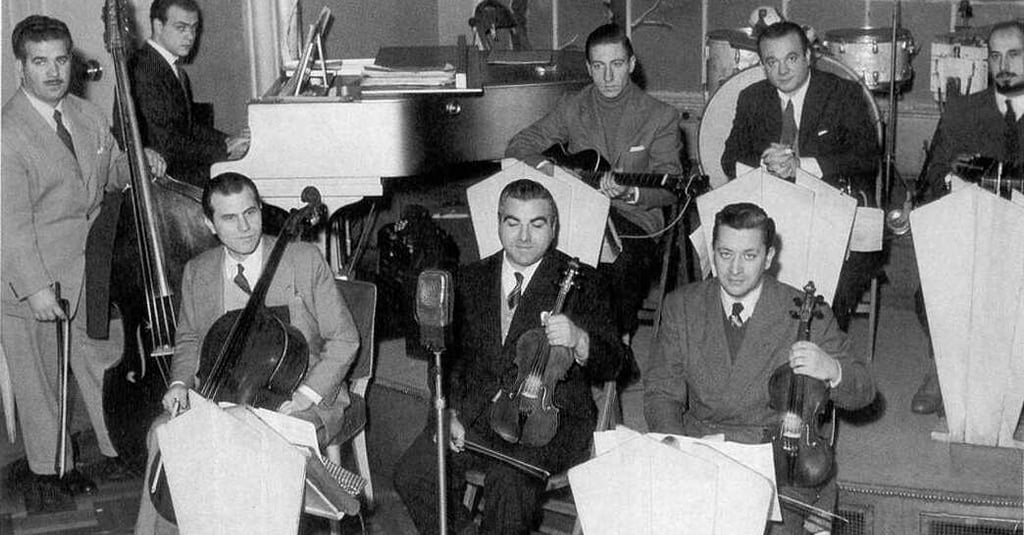
Everyone knows Piazzolla. Perhaps only a few know the man sitting to his left with a cello, which is strange, because before José Bragato, the cello essentially had no seat at the tango table at all.
Bragato's origin story reads like a novel. Born in Udine, Italy, in 1915 into a family of musicians, he emigrated with them to Buenos Aires at thirteen and studied piano until the great flood of 1930, when the River Plate overflowed, and the family lost everything, including the piano. A German cellist at the Teatro Colón, Ernst Peltz, stepped in, gave the boy a cello, and taught him for free. That borrowed instrument carried Bragato into the national conservatory and, eventually, to the principal cello chair of the Teatro Colón itself.
By day, Colón principal; by night, tango and jazz orchestras. Then in 1955, Astor Piazzolla returned from Paris and his studies with Nadia Boulanger, formed the Octeto Buenos Aires, and invited Bragato in. What Bragato brought was genuinely new: solo cello lines had never before featured in tango. His singing, sliding solos became part of the DNA of nuevo tango from its birth. You can hear him on the landmark 1956–57 recordings, and in Piazzolla's later Nuevo Octeto, Conjunto 9, and final Sextet. Piazzolla eventually wrote a piece in his honor and named it, affectionately, Bragatissimo.
But Bragato's deepest legacy may be as an arranger. At Piazzolla's own request, he became the composer's principal arranger, translating the music for duos, trios, string quartets, and orchestras. If you have ever played Piazzolla in a string arrangement, there's a good chance you were playing Bragato's handwriting. He won a Latin Grammy in 2002 for exactly this work. Meanwhile, his own compositions quietly entered the repertoire, above all Graciela y Buenos Aires, a tango for cello and strings that has become a staple of the symphonic tango repertoire. The backstory is pure Bragato: "Graciela" was a young cellist, the wife of a Swiss orchestral musician, and despite the title, she never actually made it to Buenos Aires. The piece is the trip she never took.
His life had its dark passage too: after the 1976 military coup, he left Argentina for Brazil, serving as principal cellist in Porto Alegre and teaching in Natal, returning home only in 1982. He then spent decades as an archivist and champion of Argentine composers. He died in 2017 at 101, long enough to see the cello he smuggled into tango become one of the genre's signature voices.
Listen
Bragato, Graciela y Buenos Aires (Filarmónica della Scala, live 2020): https://www.youtube.com/watch?v=HRt010tGNS4
Piazzolla's Octeto Buenos Aires recordings (1956–57), with Bragato on cello
Sources and further reading
Wikipedia, "José Bragato" — https://en.wikipedia.org/wiki/Jos%C3%A9_Bragato
The Strad, "Argentinian cellist José Bragato dies at the age of 101" https://www.thestrad.com/argentinian-cellist-jose-bragato-dies-at-the-age-of-101/6942.article
WFMT Fiesta episode on Bragato https://www.wfmt.com/2018/02/24/jose-bragato-musician-composer-conductor/
Rehearsal from Octeto Buenas Aires. By Resina78 - Own work, CC BY-SA 4.0, https://commons.wikimedia.org/w/index.php?curid=106976408