
Norway, Resonance, and a Cry for Solo Cello
What Norway's Hardanger fiddle teaches cellists about resonance and tuning, plus Arne Nordheim's Clamavi for solo cello. From my World Cup tribute series.
WORLD CUP TRIBUTE SERIES
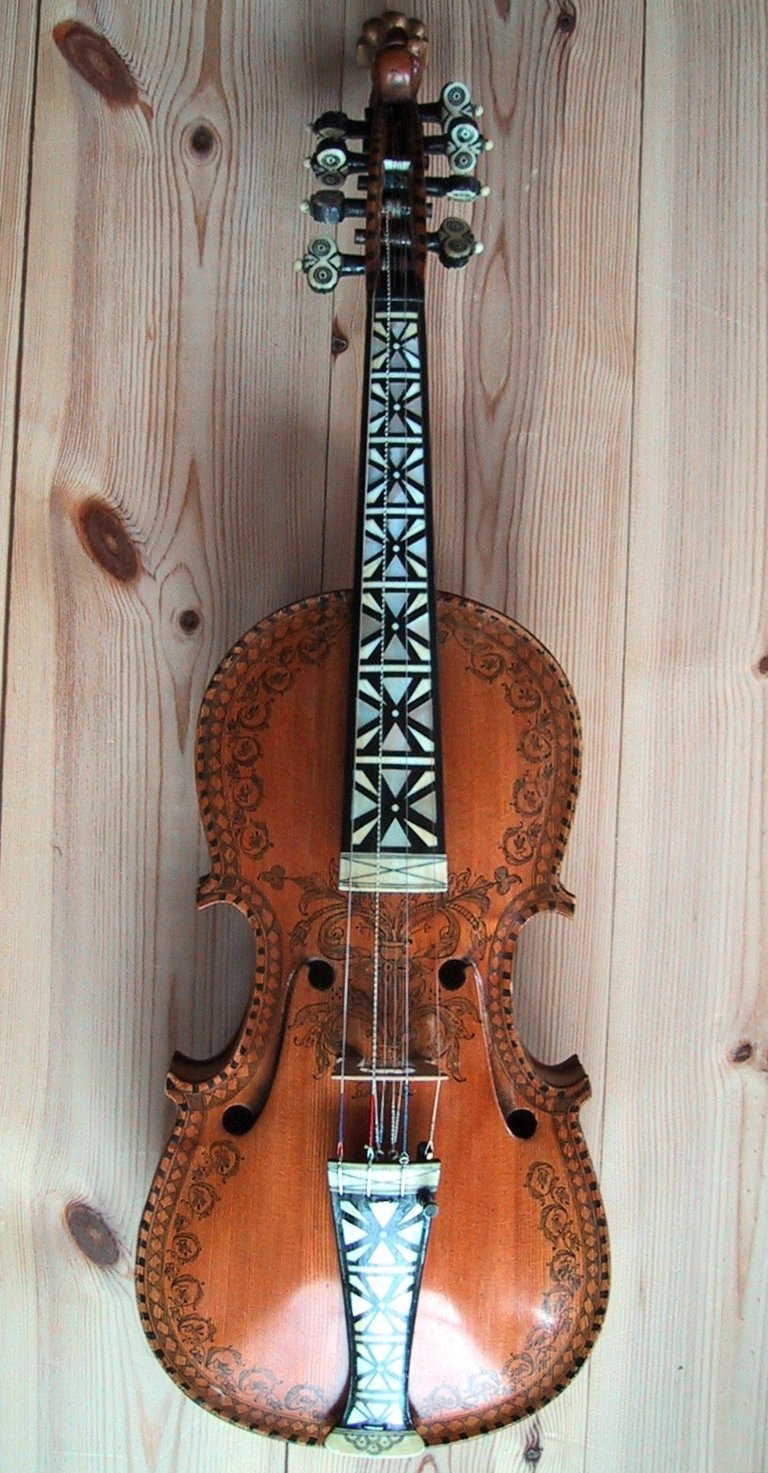
Norway's national instrument looks like a violin that wandered into a jeweler's shop: mother-of-pearl inlay, ink-drawn rosemaling swirls, a carved animal head where the scroll should be, and, if you count the pegs, far too many strings. That surplus is the whole point.
The Hardanger fiddle (hardingfele), developed in western Norway from the seventeenth century, carries four bowed strings plus four or five sympathetic strings running underneath the fingerboard, through a tunnel in the bridge. Nobody bows them. They vibrate on their own, by resonance, whenever the played strings sound their pitches — producing a shimmering, silvery halo around every note. Add scordatura tunings that change from one tune family to another, a flatter bridge inviting constant double-stops and drones, and modal melodies with flexible intonation, and you have an instrument engineered from the ground up for one value: ring.
The repertoire is the slåtter, well over a thousand documented dance tunes, handed down aurally for generations, powering regional dances like the springar and gangar. Many springar types run in an asymmetric triple meter where the three beats are of genuinely unequal length: the rhythm lives in dancing bodies, not on the page. Classical music raided this treasury early, Johan Halvorsen transcribed slåtter from the great fiddler Knut Dahle, and Grieg reworked them into his piano Slåtter, Op. 72, but the tradition itself never needed rescuing; it is alive, competitive, and expanding (Princeton's music department now has a resident hardingfele program).
So what does this have to do with the cello? Everything, because the Hardanger fiddle makes audible a phenomenon that your cello performs all the time quietly. Your cello has "sympathetic strings" too; they're just the same four strings doing double duty. Play a stopped D on the A string: if it's truly in tune, the open D string hums along and the note blooms. Play it a few cents off, and the bloom vanishes. Norwegian luthiers built a whole instrument around that bloom; cello pedagogy merely borrows it as a tuning check.
And for a modern Norwegian voice on our own instrument, meet Arne Nordheim's Clamavi (1980) for solo cello, a cry and a lament rooted in Psalm 141 ("Lord, I cry unto thee"), written as the study for his cello concerto Tenebrae. It is stark, keening, full of harmonics and long-breathed intensity: the fjord-light answer to the question "what does solo cello sound like after Bach?" Norway's great cellist Truls Mørk gets the headlines; Clamavi deserves a place on your curated listening list right beside him.
Listen
Traditional slåtter on Hardanger fiddle (Mats Edén), note the halo of the sympathetic strings
Nordheim, Clamavi for solo cello (Truls Mørk)
Grieg, Slåtter Op. 72, the folk tunes refracted through a piano
Sources and further reading
Britannica, "Hardanger fiddle": https://www.britannica.com/art/Hardanger-fiddle
Traditional hardanger fiddle making: https://www.youtube.com/watch?v=mANj0R0JAHQ
Strings Magazine, "A Trip to Norway: An Introduction to the Hardanger Fiddle" https://stringsmagazine.com/a-trip-to-norway-an-introduction-to-the-hardanger-fiddle-and-how-one-learns-to-make-them/
Princeton Music Department, "Resonant Revival" https://music.princeton.edu/about/news-stories/2025/resonant-revival-how-norwegian-folk-fiddle-found-new-voice-princeton
IMSLP, Halvorsen Slåtter (with the fiddle tunings) https://imslp.org/wiki/Sl%C3%A5tter_(Halvorsen,_Johan)
By Frode Inge Helland, CC BY-SA 3.0, https://commons.wikimedia.org/w/index.php?curid=628064