
Gaspar Cassadó
Casals's student Gaspar Cassadó wrote a great 20th-century solo cello suite and one of music's most successful forgeries. Spain in my World Cup series.
WORLD CUP TRIBUTE SERIES
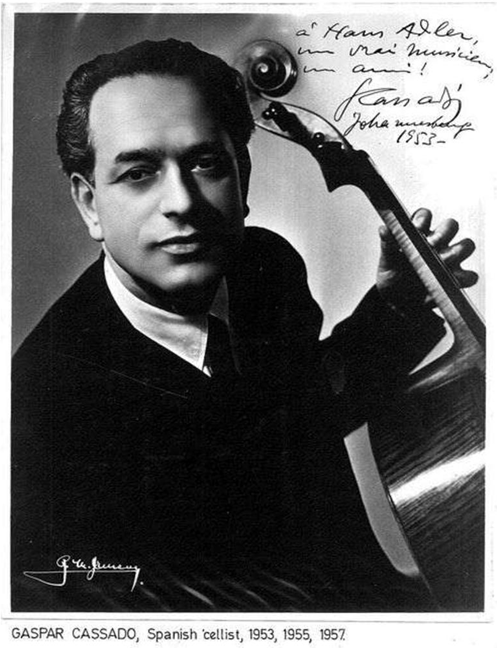
Pablo Casals is perhaps Spain's most famous cellist that needs no introduction. This post is about his student, a man who wrote one of the great solo suites of the twentieth century, committed one of music's most successful forgeries, and paid dearly for standing in a legend's shadow.
Gaspar Cassadó was born in Barcelona in 1897. At nine, he played a recital with Pablo Casals in the audience; Casals offered to teach him on the spot, and the city of Barcelona funded the boy's studies with the master in Paris, where Cassadó also studied composition with Ravel. He grew into one of the leading soloists of the interwar years and one of its most restless minds. He was the first cellist to perform publicly on a cello fully strung with steel rather than gut. He tinkered endlessly with fingerboards, tailpieces, and springs in pursuit of volume and resonance. Only the steel strings caught on, but they caught on completely. Every student playing on steel today is living in Cassadó's world.
Then there's the forgery. In 1925, Universal Edition published Cassadó's collection of "transcriptions" of classical pieces, among them a Toccata attributed to Girolamo Frescobaldi. Orchestrated by Hans Kindler in 1942, it became a hit, programmed by major orchestras, beloved by cellists. Small problem: Frescobaldi never wrote it. Scholars grew suspicious (the piece is tonal, through-composed, and behaves like Handel rather than a modal early-Baroque toccata), and analysis in the 1970s confirmed what many had guessed: Cassadó composed it himself. He was following a well-worn path. Fritz Kreisler famously did the same with his "discoveries" of Pugnani and others. The delicious irony is that the hoax proves the craft: Cassadó could write a pastiche convincing enough to fool the profession for half a century.
His masterpiece needed no disguise. The Suite for Solo Cello (1926) is a three-movement portrait of Spain itself: a Preludio-Fantasia in the spirit of a zarabanda, a central Sardana (the Catalan circle dance, its opening harmonics imitating the flaviol flute), and a finale that erupts into a jota, all strummed chords, guitar figuration, and flamenco fire. Cassadó slips in quotations of Kodály's Sonata Op. 8 and the great flute solo from Ravel's Daphnis et Chloé, a suite that knows exactly which century it lives in while dancing in older shoes. János Starker's advocacy helped bring it to wide attention, and it now sits comfortably beside Bach on recital programs.
The shadow fell after the war. Casals, fiercely anti-fascist in exile, publicly accused Cassadó of collaboration with the Axis regimes, a charge Cassadó disputed and scholars have since questioned, with Yehudi Menuhin memorably defending his colleague's gentle character. The accusation devastated Cassadó's career in the postwar years. Teacher and student eventually reconciled, but the reevaluation of Cassadó as a player, composer, and innovator has really only gained momentum in recent decades.
Listen
Cassadó, Suite for Solo Cello (János Starker)
Cassadó, Toccata "after Frescobaldi" (János Starker)
Cassadó, Requiebros (Sheku Kanneh-Mason)
Sources and further reading
Nathaniel Chaitkin, "Gaspar Cassadó: His Relationship with Pablo Casals and His Versatile Musical Life" — https://www.cello.org/Newsletter/Articles/cassado/chapter2.htm
Wikipedia, "Gaspar Cassadó" — https://en.wikipedia.org/wiki/Gaspar_Cassad%C3%B3 and "Suite (Cassadó)" — https://en.wikipedia.org/wiki/Suite_(Cassad%C3%B3)
Boston Globe, "Looking back at a forward-thinking cellist" — https://www.bostonglobe.com/arts/music/2017/03/30/looking-back-forward-thinking-cellist/ODR2dNMjkBLleqINvGyTOI/story.html
Photo credit: Hans Adler Collection / Aldercraft, via Wikimedia Commons / CC BY-SA 3.0